Learning to See – Deciphering and Diagnosing Drawings
The secret of deciphering drawings, in my view, is based on the ability to observe.
It sounds so simple, but observation is very complex and demands great responsibility. A person observing a drawing tends to project many interpretations from their own inner world, and tends to relate mostly to the drawing's content, the story, and less to the style. For example, an observer might see a drawing with a sun and blue skies, and on the surface see that the artist is happy. But sometimes further observation of the composition will reveal that the lines are fragmented, the drawing is sparse, empty, and one can understand that perhaps the artist is insecure, lonely, and not necessarily happy (of course, more drawings and data are needed for a diagnosis).
Additional elements for understanding and deciphering drawings, which I will address later in this article, include observing a series of drawings by the same person, and it is also necessary and important to check what the artist themselves sees and says about the drawing.
How to Observe a Drawing
If the artwork was created in front of the therapist, one can observe how the creator behaved — whether it was done with hesitation, apprehension and many erasures, or with enthusiasm and confidence. One can observe where the artist got stuck (in which part of the page, which part of the object) and where they drew with free flow. One can also learn from the relationship between the size of the drawn object and the background, reflecting the relationship of the "self" with the environment. Whether the object is central or peripheral, whether there are many objects, whether the colors are monotone or varied, whether the colors are intense or contrasting. This information reveals much about the artist's emotional state. For example, emotional turmoil if the colors are intense or contrasting, or conversely, emotional suppression and use of monotone colors (here too, more data and drawings are needed to determine).
Another important element in observing and diagnosing drawings is observing a sequence of drawings. It is very important, in order to understand the complexity of the artist's psyche, to see several drawings (whether made in sequence one after another in the same session, or over time), and to consider the order of works. For example, when observing a free, abstract drawing, it would be important to know what the artist's previous style was; if they drew naturalistically and precisely before, one could learn that the artist has undergone a change, it seems blockages have opened, and they have less need for control. It is also possible that the style has been abstract and free all along, but in the current drawing a new color has emerged, which also symbolizes change. Renewal and change in drawing are very important for understanding the processes and changes in the artist's psyche. Even someone who drew freely and abstractly and began to draw more naturalistically and precisely has undergone an important change. Perhaps they are more understood and clear to themselves and others. Any change in drawing style that is drawn spontaneously without directed guidance indicates an emotional change.
I personally respond to every inquiry within 24–48 hours.
 WhatsApp
When My Gaze and the Patient's Meet
Finally, if possible, it is important to listen and hear what the artist sees in their work. Sometimes, despite my extensive experience, I was surprised to hear what the artist sees in the drawing. When there is a gap between my perspective and the artist's, I examine the cause of the gap — did I not understand correctly? Did I project from my imagination? Did the artist deny what they saw? Were they frightened? Or conversely, are they unable to see their own strengths? An example of this occurred when a patient (an adult) drew a picture of a sun in light movement, with many rays. In my subjective view, I was happy to see the free movements and the rays reaching out to the world. But the patient was frightened by what she saw and thought the sun was monstrous with many hands. In trying to understand the gap between us in understanding the drawing, it was revealed that the patient was afraid to go out into the world with her strengths. As a result of this insight, she spontaneously added to the thin rays connected implicitly to the sun, thicker rays with presence and power. She left feeling good, with more confidence and permission to show her strengths rather than hide and fear them (a phenomenon that characterizes many women).
In summary, in understanding drawings, diagnosis and deciphering must be very careful, checking the elements from many perspectives before establishing a definitive diagnostic assessment. Interpretations (such as 'the lion looks predatory') and associations with what is seen should be left until the end of the process, after theoretical, phenomenological observation. The value of interpretations and additional references to drawings is important, but beyond the content, interpretation demonstrates the ability to deepen and give meaning. The ability to give meaning to a drawing is like the ability to give depth and meaning to life in general.
Read More

Art Therapy
Art therapy is an emotional therapy in which one undergoes a process of growth, development, and awareness, with the help of art materials and the power of creation…
Therapy Demonstration
A demonstration of an art therapy process, step by step, accompanied by drawings and insights from the therapy room…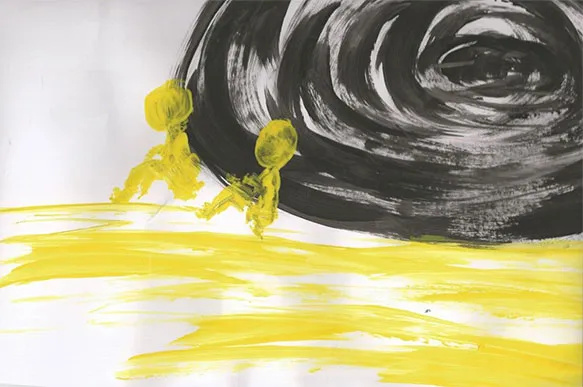
Art Therapy and Focusing
The Focusing approach is based on a process of listening to inner experience, paying attention to body sensations and images that arise…Want to know more?
I'd be happy to meet, answer questions, and help you get started.
Contact us for a consultation and appointment Focused depth meeting