"Doodles", Drawing, and Self-Confidence: What's the Connection?
Why are scribbles, drawing, visual images, and benevolent responses so important?
They enable experimentation and a space for exploring the question: "Who am I?" They allow feeling joy, pleasure, satisfaction, and calm. The child gains a space where they can learn and discover their abilities.
Drawing and scribbling enable free forms of expression that grant courage and confidence, and the ability to trust yourself and build an independent identity. All of these are tools that contribute to building high self-esteem.
Scribbling and drawing also open an additional, alternative space where one can take up space, see and be seen. It is a place to express the full range of inner emotions, a bridge between the inner world and the outer world, a tool for recognition and enrichment of the world of imagination and the real, tangible world.
Scribbling and drawing help improve planning and organizational skills, perseverance and commitment. They are wonderful tools for developing symbolization and imagination, and also for improving the child's expression and interpersonal communication skills, serving as a means of bringing parents (and other significant figures in the environment) closer to their children.
And to the mother who asks me: Why does my child never draw? Why were their drawing drawers in kindergarten always empty? I usually explain: Scribbling and drawing are created naturally and intuitively everywhere and in every way. The toddler will scribble at the beach or during play, or while eating porridge. Children who "don't draw" sometimes came to me for therapy — and lo and behold — the child began to love drawing and enjoy it.
How did this happen? I didn't do much. I "simply" listened to the drawing without expectation and with great enjoyment of what it brought. And it worked. The child began to draw with joy and love.
I personally respond to every inquiry within 24–48 hours.
 WhatsApp
So why do some avoid drawing on paper? Expectations. It may be that drawing on paper dictates more expectations for results — expectations that the child picks up from the environment, which affect their ability to create in the form of "performance anxiety." Perhaps if that same child had grown up in the jungle, they would draw freely, in a place where expectations for results hadn't spoiled the toddler's natural tendencies.
True, not all children are equal in their mastery of scribbling and drawing abilities. There are children with higher or lower abilities and control, developmental disorders, motor issues, and attention and concentration difficulties (which are sometimes worth investigating). But what happened to the love of just playing? Creating just for the joy of it? In this book, we won't deal with differences in abilities, but with the love of play and the creation that is possible and important for the development of each one of us.
Read More
Art Therapy
Art therapy is an emotional therapy in which one undergoes a process of growth, development, and awareness, with the help of art materials and the power of creation…
Therapy Demonstration
A demonstration of an art therapy process, step by step, accompanied by drawings and insights from the therapy room…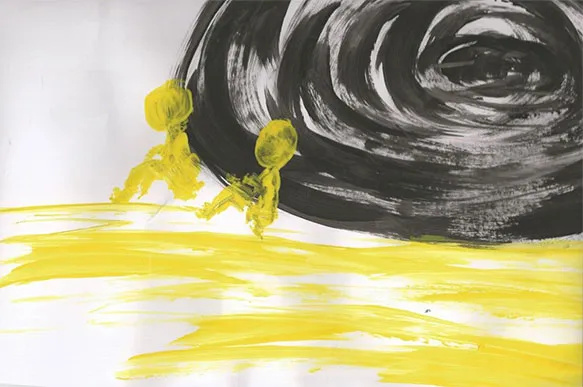
Art Therapy and Focusing
The Focusing approach is based on a process of listening to inner experience, paying attention to body sensations and images that arise…Want to know more?
I'd be happy to meet, answer questions, and help you get started.
Contact us for a consultation and appointment Focused depth meeting